MPLC, AVLA & Filmbank Licensing
Licensing the installation of TVs in hotel bedrooms and hospitality premises
What does the TV licence cover and surely an additional licence is not necessary?
A standard TV licence only covers the reception of live television broadcasts. It does not cover the copyright authorisations to publicly perform or communicate to the public, musical compositions, sound recordings, commercial films, and audiovisual works. As a result, licences are required from PPL PRS, MPLC, AVLA & Filmbank for TVs installed by the operator into hotel bedrooms.
The difference between Public Performance & Communication to the Public
A public performance involves showing, playing, or performing a copyrighted work live or via pre-recorded media in front of an audience in a physical, shared space. A communication to the public refers to the electronic transmission of a work, such as internet streaming or broadcasting, allowing individuals to access it remotely.
Which rightsholders do the different Copyright Licensing Bodies represent that license the installation of TVs in Hotel Bedrooms
PRS (Performing Right Society) represent the composers & publishers of musical works

PPL (Phonographic Performance Ltd) represent the record labels and artistes who perform on the sound recordings

MPLC (Motion Picture Licensing Corporation) represent a large body of major Hollywood, Bollywood & independent film & TV producers

AVLA (Audiovisual Licensing Alliance) represents a coalition of audiovisual creators, including producers, authors, performers, directors and writers

Filmbank is a joint venture between Warner Bros, Sony Pictures and NT Digital, representing major Hollywood studios and specialising in Non-Theatrical Film & TV content licensing
What are the legal precedents allowing PPL PRS, MPLC, AVLA & Filmbank to license the installation of TVs in Hotel Bedrooms
In respect of hotel bedrooms, while widely accepted that the public viewing right exists outside the bedroom, it was the case of Sociedad General de Autores y Editores de España (SGAE) v Rafael Hoteles SA (C-306/05 heard in the European Court of Justice) that ruled that the distribution of a signal by means of TV sets by a hotel to customers staying in its rooms constitutes "communication to the public" and that the private nature of hotel rooms does not preclude the communication of a work . . . from constituting communication to the public.
In that case, the court held that a broadcast of works to hotel guests would be a broadcast to the 'public'. The reasoning behind this decision was that television and Video on Demand (V.O.D) broadcasts are generally licensed on the basis that they will be viewed by an audience privately in a domestic setting. Hotel guests, when viewed collectively are not the audience whom the author had in mind when licensing the broadcast. The hotel also derives economic benefit from offering those services. In the view of the Court, these factors suggested that broadcasts of the protected works to guests in hotel rooms were made 'in public'.
It was then the case of Phonographic Performance (Ireland) Limited v. Ireland, in case C-162/10, 15 March 2012 (again heard in the European Court of Justice) that confirmed that not only are public viewings from broadcast signals needing to be licensed, but also public viewings from physical and digital sources must also pay equitable remuneration.
For these reasons, the broadcast of works belonging to PPL PRS, MPLC, AVLA & Filmbank rightsholders to guests via television in their hotel room constitutes a communication of the works in 'public' in terms of s.16(1)(d) of the CDPA. To do so without the copyright holders' consent is infringement of the copyright in those works under s.20 CDPA.
Other more recent cases from 2024 have been heard in the ECJ which have cemented the findings above.
Surely EU legal precedents allowing the licensing of TVs in Hotel Bedrooms do not apply in the UK as we have left the EU.
The argument that this is European law & not UK law so does not hold any legal basis is inaccurate. Following Brexit, this decision remains directly binding on the lower courts in the UK as retained law under the European Union (Withdrawal) Act 2018, in that it deals with the application of Directive 2001/29/EC. As such, the decision could only be overturned by the Court of Appeal of England and Wales or the Inner House of the Court of Session in Scotland, as per the European Union (Withdrawal) Act 2018 (Relevant Court) (Retained EU Case Law) Regulations 2020.
Since Brexit, the courts across the UK have applied the approach to defining the 'public' set out in the Rafael case for the purposes of s.16 of the 1988 Act (see the Court of Appeal case Warner Music UK Ltd and another v TuneIn Inc (2021) Bus LR 1119 at para 70 and the Court of Session, Outer House, case of Sky Ltd v Airlie (2024) SLT 279 at paras 48-52 in this regard).
Why have MPLC from 2016, AVLA since 2024 & Filmbank since September 2026, started licensing the use of TVs in Hotel Bedrooms
The use of home entertainment DVD/Blu-ray and downloads/streaming (whether film or TV show) had been licensable under the provisions of the Copyright, Designs and Patents Act 1988 (CDPA) for many years, however, the broadcast of film was exempted even though licences for the broadcast of the music were required from PRS & PPL. Following changes to Section 72 of the CDPA in 2016 the showing of broadcast films and television in public required a licence. As a result, films and TV shows from MPLC's studio partners, whether broadcast on TV, on home entertainment DVD/Blu-ray or viewed from the internet if shown in hotels, restaurants, pubs, shops, clubs and other similar premises, required a MPLC licence.
On page 3 of the Intellectual Property Office Guidance document on these changes they state:
"What does This Mean: The removal of 'film' from Section 72 means that those wishing to show broadcasts in public may need to gain the permission of film rightsholders to show the film contained within a broadcast, as is currently the case for certain other rights. Separate licences may still be required from PRS and PPL in relation to music contained in a broadcast, as well as any other underlying rightsholder who chooses to enforce/license their copyright"
IPO guidance: Changes to Section 72 (gov.uk)
In regard to the wording public place, works may be shown without a licence in the home to a normal circle of family and its social acquaintances because such showings are not "public." Any performance outside a "domestic and private context" is considered a public performance. (Ernest Turner Electrical Instruments Ltd v PRS Ltd [1942] CH 167).
AVLA came onto the licensing scene in 2024. They describe themselves as an "Alliance of Creatives" offering "the most comprehensive audiovisual licence for hotels & similar hospitality premises". They have been set up by some very well-known CMOs such as ALCS, BECS, DACS, AGICOA as well as Directors UK & PICSEL. The changes to Section 72 of the CDPA in 2018 provides the legal basis for their ability to issue licences.
Filmbank started licensing in September 2026. They describe themselves as committed to protecting intellectual property and that for 40 years they have been a trusted partner to Hollywood majors (including Warner Bros. Discovery & Sony Pictures), independent studios and local rights holders.
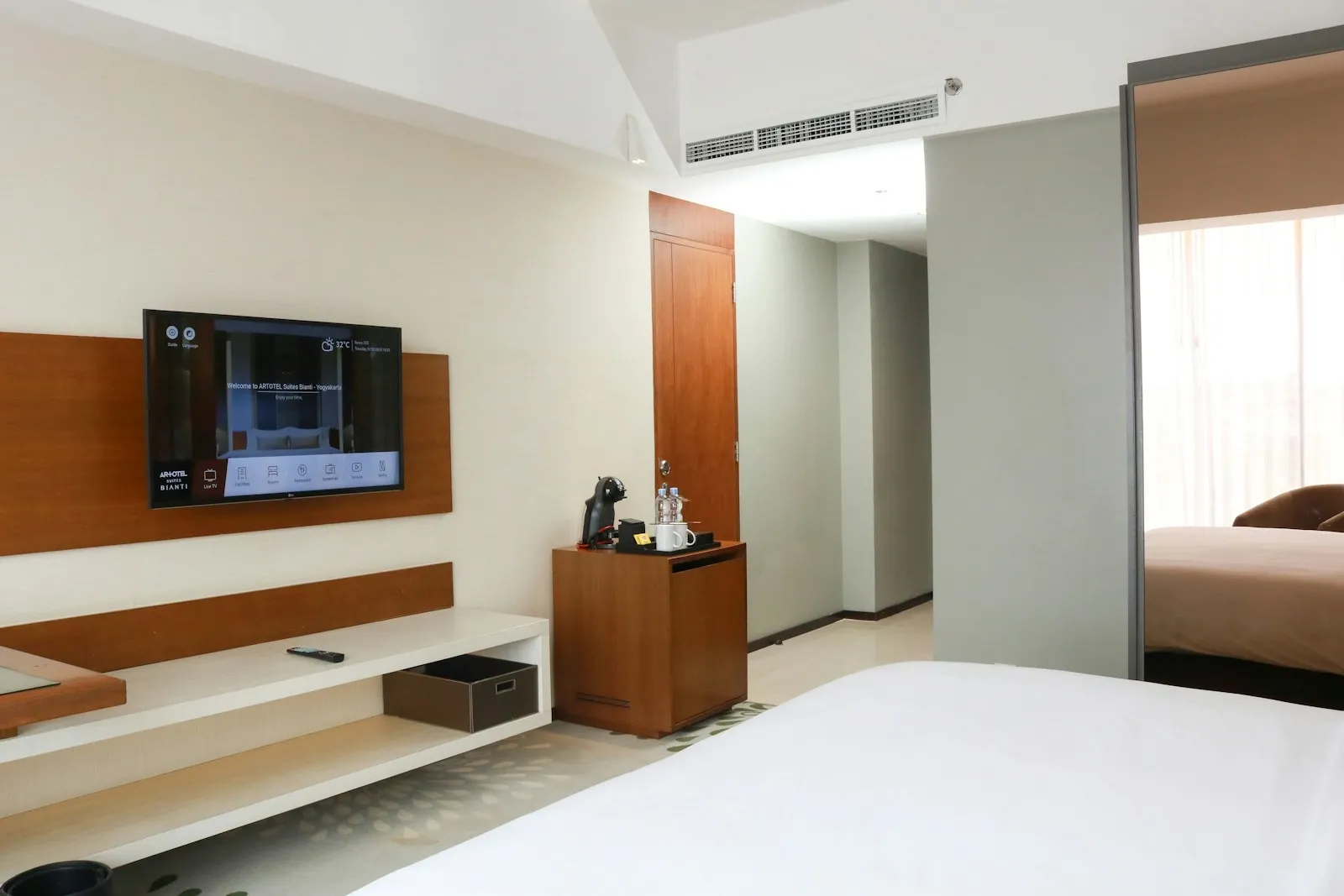
Some examples of TV productions available on TVs installed in Hotel Bedrooms that MPLC, AVLA & Filmbank license on behalf of their rightsholders
AVLA
Peaky Blinders, Grantchester, Master Chef, Peppa Pig, Midsomer Murders, Hollyoaks, All Creatures Great and Small, Goggle Box, Masked Singer, Cash in the Attic, Antiques Road Trip, Bridge of Lies, Rebus, Taggart, Bake Off, The Great Sewing Bee, Shaun the Sheep, Wallace and Gromit, Professor T, Hotel Portofino, The Couple Next Door, Before We Die.
MPLC
Coronation Street, Emmerdale Farm, Have I Got News for You, EastEnders, Strictly Come Dancing, The Graham Norton Show, Doctor Who, Ant & Dec's Saturday Night Takeaway, Dancing on Ice, The Chase, This Morning, Loose Women, I'm a Celebrity Get Me Out of Here, Cold Feet, Britain's Got Talent.
Filmbank
Who Do You Think You Are, First Dates, The Bidding Room, Glow Up: Britain's Next Make-Up Star, Who Wants to Be a Millionaire, Waterloo Road, Millionaire Hot Seat, Big Bang Theory, Young Sheldon, Everybody Loves Raymond, Mike & Molly, The Middle.
Challenging the rights to license
When MPLC started to license in 2016, they were challenged by many in the hospitality industry. MPLC's contention then, was that UK Hospitality, the BBPA and other trade associations had not challenged PRS and PPL's rights to collect fees for TVs in bedrooms and that PRS & PPL had introduced their tariffs many years earlier and had not to their knowledge, been challenged or more importantly, the right to license hotel bedrooms, had not been challenged.
UK Hospitality and the BBPA then, and even now consider that a "grey area" exists in the case of MPLC's rights, but not for PRS & PPL which is a view that MPLC have consistently challenged. The reasons for this disparity have to date not been clarified. Anecdotally and from personal knowledge many within the industry (albeit not all) have accepted the requirement to obtain a MPLC licence.
AVLA since January 2024 & Filmbank since September 2026 are effectively the "new kids on the block", exercising and enforcing their rights. For members of UK Hospitality & BBPA a briefing document is available on their websites covering MPLC, AVLA & Filmbank.
It is understandable that post-Covid and, in a cost-of-living crisis that the hospitality sector would wish to reduce running costs rather than pay for "yet more licences". In conclusion, however it is my opinion, that AVLA & Filmbank's rights do stand alongside those of MPLC & PPL PRS when it comes to the licensing of hotel bedrooms.
The above observations and comments do not constitute legal advice.
David Newham
25th September 2026
Need help with MPLC, AVLA or Filmbank licensing?
DNA can advise on which licences apply to your premises and obtain them on your behalf. See the current MPLC, AVLA and Filmbank tariffs or contact details for all the UK copyright licensing organisations.
Contact DNA